


Talathi and Mamlatdar in Goa: Their Roles, Powers,and Importance in Property Transactions

Written by JONAH DA COSTA
Dated 23/06/2026
A Comedic Tale of Talathi and Mamlatdar in Goa
Once upon a time in the sunny paradise of Goa, where the beaches are as beautiful as the people are laid back, two government officials were the unsung heroes of property transactions: Talathi and Mamlatdar. But let’s be honest, they were more like the dynamic duo of confusion than anything else.
The Mysterious Talathi
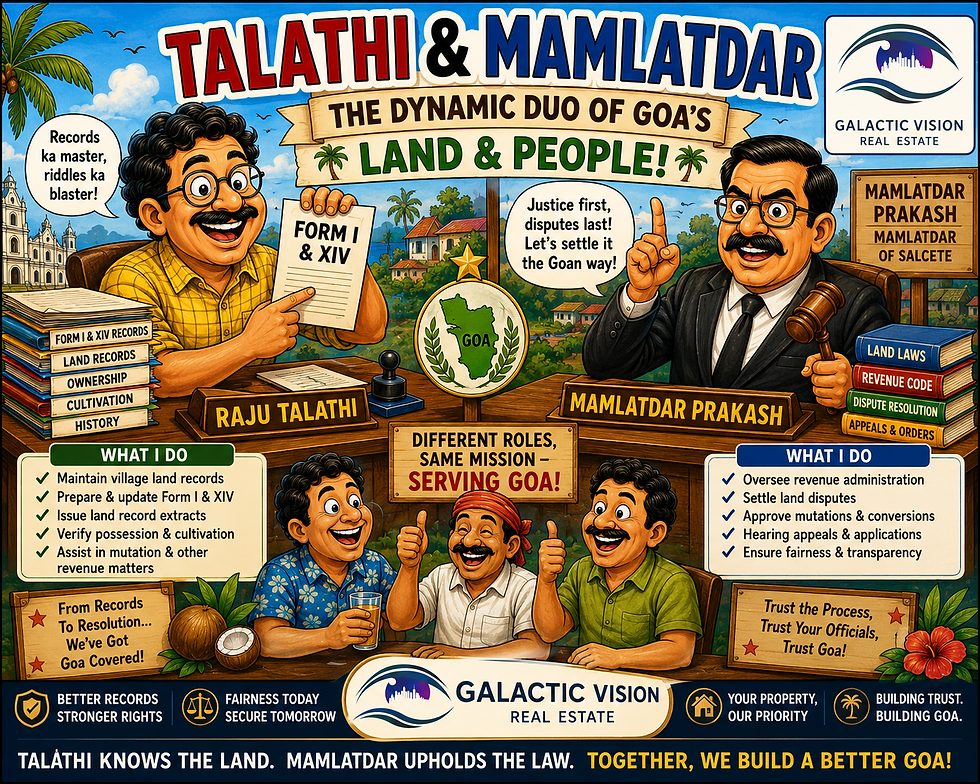
Meet Raju, the Talathi of a small village in South Goa. Raju was known for two things: his impeccable record-keeping skills and his ability to turn any mundane conversation into a comedy show. One day, a property buyer named Vinod came to him, flustered and desperate. “Raju, I need to buy some land for my beach shack! Can you help me?” Vinod exclaimed. “Of course! But first, let’s check the Form I & XIV records!” Raju replied, pulling out a stack of papers that looked like it had survived a tsunami. Vinod stared at the papers, bewildered. “Is that a form or a recipe for Goan fish curry?” Raju chuckled, “If it were a recipe, I’d be a Michelin star chef by now! But alas, it’s just paperwork. Let’s see… Ah! Here it is! Your land is as clear as my auntie’s gossip!” Vinod sighed in relief, “So, I can buy the land?” “Only if you can solve this riddle: What has keys but can’t open locks?” Raju grinned. Vinod scratched his head, “A piano?” “Correct! Now you can buy the land!” Raju clapped, as Vinod rolled his eyes, “Why do I feel like I just got played?”
The Mighty Mamlatdar
Now, enter the Mamlatdar, a serious looking man named Prakash, who took his job very seriously. He was known for his stern demeanor and the ability to make even the simplest of tasks sound like a court case. One day, he had to settle a dispute between two neighbors arguing over a boundary line. “Ladies and gentlemen, welcome to the court of Mamlatdar Prakash!” he announced dramatically. “Today’s case: Who owns the coconut tree that’s leaning dangerously close to the boundary?” The crowd gasped. “I do!” shouted one neighbor. “No, I do!” yelled the other. Prakash, with a theatrical flair, leaned forward and said, “Let’s settle this like true Goans. A coconut eating contest!” The neighbors paused, confused. “But… we want the land!” “Exactly! But first, let’s see who can eat more coconuts! The winner gets the tree, and the loser gets to plant a new one!” Prakash declared, his eyes twinkling with mischief. The crowd cheered, and soon the two neighbors were cracking coconuts like they were in an Olympic event. In the end, they both ended up with bellyaches and a newfound friendship, realizing that sometimes, it’s better to share the coconuts than to fight over them.
The Grand Finale
As fate would have it, Vinod and the two neighbors ended up meeting at the local tavern after their respective adventures. They shared their stories of the Talathi's riddles and the Mamlatdar’s coconut contest, laughing until they cried. “Who knew property transactions could be this entertaining?” Vinod chuckled, raising his glass. “To Raju and Prakash, the real MVPs of Goa!” And so, in the land of sun, sand, and spice, the Talathi and Mamlatdar became legends: not just for their roles in property dealings, but for the joy and laughter they brought to the sometimes tedious world of land records. In the end, everyone learned that while paperwork might be a serious business, a little humour goes a long way in making the journey a lot more enjoyable. As they left the tavern, Vinod looked at his newly purchased land documents and smiled. "You know," he said, "buying land in Goa wasn't nearly as complicated as everyone warned me." Just then, Raju appeared from nowhere and asked, "Excellent! Now, one last riddle before I stamp your file..."
Vinod groaned, the neighbors laughed, and somewhere in the distance, a coconut fell dramatically from a tree.

Anyone buying land or property in Goa will inevitably come across two important government officials: the Talathi and the Mamlatdar.
Whether you are purchasing agricultural land in South Goa, applying for mutation after a property purchase, verifying Form I & XIV records, or dealing with inheritance-related property matters, understanding the role of these officers is essential.
Many property buyers focus exclusively on sale deeds, title documents, and registration. However, revenue records maintained by the Revenue Department often play an equally important role in establishing possession, occupancy, and the history of a property.
This article explains the roles, responsibilities, and powers of Talathis and Mamlatdars in Goa and how they affect property ownership and land transactions.
Understanding Goa's Revenue Administration System
Land records in Goa are maintained through a hierarchical revenue administration system.
The structure generally includes:
• Revenue Department
• Collector
• Deputy Collector
• Mamlatdar
• Talathi
At the grassroots level, the Talathi is usually the first point of contact for landowners and property buyers.
The Mamlatdar supervises revenue administration at the taluka level and performs quasi-judicial functions in many property-related matters.
Who Is a Talathi?
A Talathi is a village-level revenue officer responsible for maintaining land and revenue records within a designated area.
The Talathi is often the first government official approached by property owners seeking information about land records.
In practical terms, the Talathi serves as the custodian of many day-to-day revenue records relating to land ownership and occupation.
Key Responsibilities of a Talathi in Goa
1. Maintaining Revenue Records
One of the primary responsibilities of the Talathi is maintaining revenue records relating to land.
These records include:
• Form I & XIV
• Mutation records
• Occupancy records
• Land revenue records
• Agricultural land records
The accuracy of these records is crucial for future property transactions.
2. Processing Mutation Applications
After a property sale, inheritance, gift, or partition, the new owner must update government revenue records.
The Talathi plays a critical role in processing mutation applications.
Responsibilities include:
• Receiving mutation requests
• Examining supporting documents
• Recording proposed changes
• Conducting preliminary verification
• Forwarding matters for approval where necessary
Many property transactions remain incomplete from a revenue perspective until mutation records are updated.
3. Maintaining Form I & XIV Records
Form I & XIV is one of the most important property documents in Goa.
It contains:
• Survey number
• Land area
• Occupant details
• Nature of rights
• Existing entries
Talathis help maintain and update these records whenever legally permitted changes occur.
4. Collection of Land Revenue
Historically, Talathis were responsible for assisting in land revenue collection.
Although modern systems have changed many procedures, revenue administration remains one of their core functions.
5. Field Verification
In certain cases, the Talathi may conduct field inspections or local verification.
These inspections may involve:
• Confirming occupation
• Verifying land details
• Investigating boundary-related issues
• Reviewing mutation claims
Such inspections help maintain accurate government records.
Who Is a Mamlatdar?
A Mamlatdar is a senior revenue officer who exercises administrative and quasi-judicial powers at the taluka level.
The Mamlatdar supervises Talathis and oversees various revenue-related matters.
In many property disputes and mutation-related proceedings, the Mamlatdar acts as the
decision-making authority.
Key Responsibilities of a Mamlatdar in Goa
1. Supervising Revenue Administration
Mamlatdars oversee the functioning of Talathis and ensure proper maintenance of land records.
They are responsible for:
• Revenue administration
• Record management
• Land-related proceedings
• Government directives implementation
2. Hearing Mutation Matters
Certain mutation cases may involve:
• Objections
• Ownership disputes
• Competing claims
• Inheritance conflicts
In such situations, the Mamlatdar may conduct hearings and make decisions based on available evidence.
3. Resolving Revenue Disputes
Many land-related disputes are initially addressed through revenue authorities.
Examples include:
• Occupancy disputes
• Boundary disputes
• Mutation objections
• Revenue record corrections
The Mamlatdar frequently plays a key role in resolving such issues.
4. Issuing Revenue-Related Orders
Mamlatdars may issue orders concerning:
• Mutation entries
• Revenue record corrections
• Administrative proceedings
• Land-related applications
These decisions can significantly impact property transactions.
5. Oversight of Village Revenue Administration
Mamlatdars ensure that village-level revenue administration functions efficiently and in accordance with applicable laws.
Difference Between a Talathi and a Mamlatdar
Talathi:
• Village-level officer
• Maintains records
• Processes applications
• Conducts preliminary verification
• First point of contact
Mamlatdar:
• Taluka-level officer
• Supervises records
• Decides disputed matters
• Conducts hearings
• Supervisory authority
Both officers play important but distinct roles in Goa's revenue administration system.
Why Property Buyers Should Understand These Roles
Property buyers often encounter issues such as:
• Delayed mutations
• Incorrect Form I & XIV entries
• Ownership discrepancies
• Boundary disputes
• Inheritance complications
Understanding which authority handles each matter can save significant time and prevent
unnecessary delays. Importance During Property Due Diligence
Before purchasing land in Goa, buyers should examine:
• Form I & XIV
• Survey plan
• Mutation history
• Occupancy records
• Revenue entries
Many of these records are maintained or processed through the offices of the Talathi and
Mamlatdar. Proper verification can reveal issues that may not appear in the sale deed alone.
Common Mistakes Made by Property Buyers
Many buyers:
• Ignore mutation records
• Rely solely on sale deeds
• Fail to verify Form I & XIV
• Overlook pending objections
• Do not check historical revenue entries
These mistakes can create significant complications after purchase.
How Talathi and Mamlatdar Offices Help During Mutation
A typical mutation process often involves:
1. Submission of application
2. Verification by Talathi
3. Recording of proposed entry
4. Notice and objection stage if required
5. Review by competent authority
6. Final update of revenue records
Understanding this process allows buyers to track their applications effectively.
Conclusion
Talathis and Mamlatdars are key players in Goa's land administration scene. Talathis handle the village-level revenue records, while Mamlatdars oversee the whole revenue administration and often settle disputes about land records and mutations.
If you're buying property, investing, developing, or owning land, knowing what these roles do is crucial. Checking revenue records, mutation history, and Form I & XIV entries properly can save you from expensive disputes and make the whole property transaction smoother.
Whether you're looking at land in Varca, Orlim, Benaulim, Cavelossim, Carmona, or anywhere else in Goa, understanding the Talathi and Mamlatdar system can safeguard your investment and enhance your due diligence.


Comments